Article
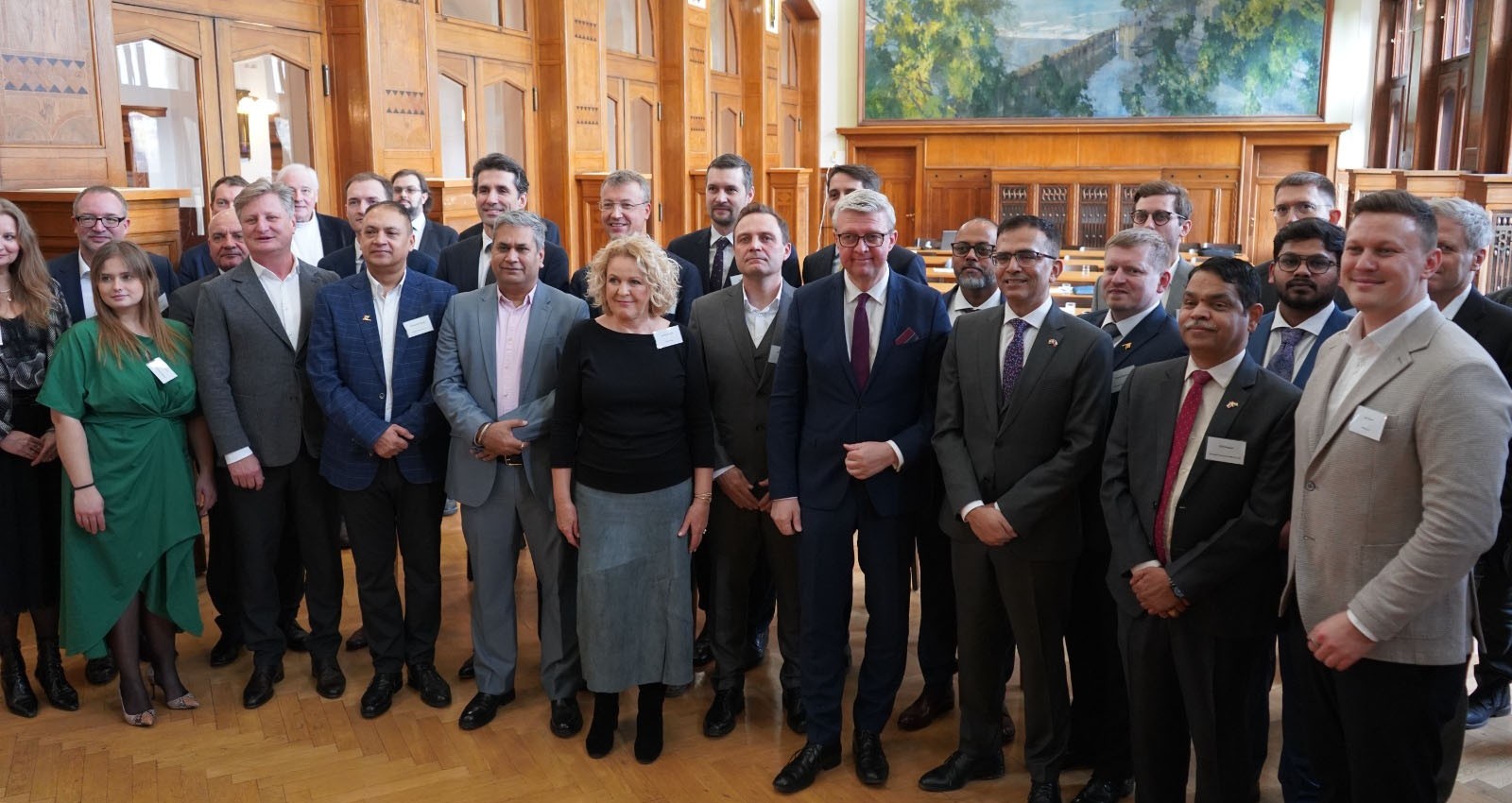
The interview was originally published on iTradeNews. Jan Musil and the LIKO-S team are among our colleagues from CZINCC, and they are also based in nearby Slavkov u Brna.
At the time this interview was created, Jan Musil was in India. “This is my first trip here in my role as President of the Czech-Indian Chamber of Commerce (CZINCC), and it also comes shortly after the conclusion of the free trade agreement between the EU and India. In every meeting with local companies, you can suddenly feel a completely new dynamic in cooperation with Europe. And, in fact, a general hope for even better growth of the Indian economy. A truly great time for European companies in India is now coming."
Courage, perseverance and “good karma”
You have nearly fifteen years of experience doing business in this country. You launched it with your father and LIKO-S founder Libor Musil. What did you learn about India in the process? What is the secret of your success?
For a Czech company to succeed in India, it needs a combination of courage, perseverance, and also a fair amount of luck. Or perhaps rather “good karma”. These elements are reflected in our company’s story as well.
Can you describe it in more detail?
In 2012, we “coincidentally” met an entrepreneur from Bengaluru at the International Engineering Fair in Brno, with whom we had much in common, and thanks to his enthusiasm we immediately established a friendly connection. It sparked our interest in this mystical country. Even though we had never considered India before, just a few months later we set out on our first business trip without any prior knowledge. That entrepreneur was Mr C.S. Prakash, who helped us secure our first Indian contracts and later became Honorary Consul of the Czech Republic in Bengaluru. Together with him, the Ministry of Industry and the Association of Small and Medium-Sized Enterprises and Crafts of the Czech Republic, we opened the first Czech incubator in his office building, through which several companies passed — and successfully established themselves on the Indian market.
When in 2017 my father and I stood before a turning-point decision about what to do next in India (until then, we had imported products there and sold them through local business partners), we told ourselves we had two options. Either we would say goodbye to our dream of commercially conquering the Indian market and only travel to the country as tourists who had fallen in love with it. Besides its enormous market potential, we had also grown deeply fond of Indian culture and its amazing, intelligent and humble people. Or we would go all in, establish a full-fledged branch, and launch production here as well, because importing products had proved to be the biggest limit to our growth. We chose the second path, without realising at the time that this placed us among just a few Czech companies operating directly in India.
And how did it turn out?
A series of expensive mistakes followed, which slowed our expansion. Unfortunately, at that time we had no one to consult on important practical matters such as recruitment, branch financing, or building a supply chain.
Today, our Indian branch is successfully operating independently and growing steadily. At the same time, we are managing to win contracts there in neighbouring Southeast Asian countries, and through Indian companies active in the Middle East we supply our products to skyscrapers, for example in Qatar.
India is changing dynamically — you have to see it with your own eyes
What is today’s Indian market like from the perspective of someone who has known it for a long time and does business there?
It is growing really fast — not only in volume, but also in terms of quality demands. Ten years ago, we struggled to explain to customers why they should address acoustics in offices and that we could refine the details of our glass and movable partitions much better so that the overall aesthetic impression was truly premium. Today, the growth limit of our Indian branch is rather the recruitment and development of quality local people and the associated transfer of know-how.
One significant obstacle is the complex visa policy on the Czech side. Obtaining a business visa takes far too long compared to our neighbouring countries, and obtaining work visas for Indians is practically impossible (for example, even short-term visas so they can be properly trained in the Czech Republic and then return to work for us in India).
And this is exactly where the circle naturally closes for me, when I found out that many companies on both sides face the same problems. Over recent years I have confirmed one thing again and again: Czech-Indian cooperation has deep roots, but the real potential is still significantly underused. And today, it is no longer only about “export to India”. India has its Make in India strategy, and for many sectors local presence (production, assembly, service, team) is almost a necessary condition for growth. At the same time, this is exactly the type of long-term industrial cooperation in which Czech companies have much to offer.
When forces are joined, success is easier
Was this where you began considering the establishment of the Czech-Indian Chamber of Commerce?
Yes, I had carried the idea of establishing the chamber in my head for several years, and it gradually took shape through conversations with other companies that were encountering similar barriers and showing interest in such a platform. In the end, however, I was surprised that nearly twenty of them decided to become founding members of the chamber in a binding way — at a time when the chamber was still only a concept. For me, it was strong confirmation that we were heading in the right direction.
The Indian Ambassador in Prague, Mr Raveesh Kumar, also deserves great credit for the chamber’s creation and initial operation. From the start of his tenure, he very proactively visited Czech companies active in India (including ours) and took a personal interest in how he could help them. When I mentioned the chamber idea to him, he was immediately enthusiastic, and thanks to his energy the plan was realised.
At the same time, he has managed to connect very well-functioning Indian communities in the Czech Republic, which is another source of potential for business cooperation between companies from both countries. For the chamber to function effectively, you need Czech professionals with experience of doing business and living in India, and ideally also Indian managers, engineers or students who have already spent some time in the Czech Republic and “absorbed” our culture. The easier the mobility of business people between the two countries (for example, also thanks to experience gained within a multinational operating in both markets), the easier it will be for companies to enter the other market.
How did you manage to officially establish the new chamber of commerce on exactly the day the EU-India free trade agreement was signed? As far as I know, that date was not known in advance.
Here we return to that “good karma” that also accompanied the creation of CZINCC. We officially established the chamber on 27 January 2026 at the Ministry of Industry and Trade in Prague. We selected the date and place in advance for a certain symbolism — and in the end it turned out to be even more meaningful. It was the day after the 77th Republic Day of India, and an official reception of the Indian Embassy had been scheduled for that same evening for the occasion. But only in the morning did we learn that the already mentioned free trade agreement between the EU and India had just been concluded — after nineteen years of work.
Who else provided major support for the chamber’s establishment?
Support from the Ministry of Industry and Trade and specifically Minister Karel Havlíček was key for us. In the past, we had occasionally encountered a lack of understanding from public administration about how great an opportunity close cooperation with India can represent for the Czech economy. We were therefore very grateful that the minister, through his personal attendance, confirmed the Czech Republic’s interest in further developing historically already very good trade relations with India. We hope to follow this up soon with an official Czech business mission to India, because we believe that many Czech companies still cannot correctly assess how much potential the Indian market may hold for them, not only today but especially in the coming decades. And from my personal experience, I know well that this incredible Indian growth energy cannot be transferred: you simply have to experience it first-hand. From the other side, we would again like to bring a delegation of Indian companies to the International Engineering Fair in Brno and organise the first Czech-Indian Business Summit.
I am pleased that a board was elected as the chamber’s governing body, in which I was joined by very successful businesspeople with enormous experience in the Czech-Indian environment. Jan Skoták serves as branch director for Central and Eastern Europe of India’s largest IT company, Infosys, and has been helping it build long-term business in the Czech Republic for more than twenty years. Shashidhar Singh was elected as second vice-president — an excellent example of an Indian citizen who fell in love with the Czech Republic, started a family here, and built a successful business supplying medical aids worldwide.
Is there anything that significantly distinguishes your chamber of commerce from similar entities?
What is unique about our chamber is that from the very beginning it has had a strong membership base, which will continue to grow. Members include small and medium-sized enterprises as well as well-known large companies such as Czechoslovak Group, Infosys, Wikov, Lasvit, BDO and Dookan. Active involvement of members is very important to us so that we truly make full use of shared know-how.
In addition to creating various guides and checklists with experts for entering both markets, we will also strive to facilitate everyday communication among members. At the same time, our ambition also includes longer-term strategic cooperation among members, for example supporting the creation of joint industrial parks that can accelerate market entry and reduce risks for multiple companies at once.
In India today, enormous demand for technology, manufacturing, infrastructure and know-how naturally meets what Czech companies are traditionally strong in: mechanical engineering, industry, engineering, quality, and the ability to deliver well-thought-out solutions. At the same time, however, the game is fundamentally changing: for most companies, it is no longer only about producing in one country and exporting products halfway around the world. To succeed in India in the long term, they often need to build their own operations in the other market. And this is exactly where we want to help as a chamber: connect, accelerate learning, reduce risks, and speak with one voice on critical topics.
Author Jana Jenšíková
Jan Musil
Jan Musil serves as Chairman of the Board of the family company LIKO-S, a.s., and also leads its foreign branches, including the Indian one. He has been developing business cooperation with India since 2012. In 2021, he took over management of the construction part of the holding from his father, Libor Musil. He is the president of the recently established Czech-Indian Chamber of Commerce.
Czech-Indian Chamber of Commerce (CZINCC)
is a member-led non-profit platform connecting companies active in the Czech Republic and India. It was founded by seventeen companies and focuses on sharing practical know-how, connecting companies with vetted experts, and coordinated advocacy towards authorities (e.g. on visa policy and investment conditions).
Contact: info@czin.cc | www.czin.cc
Members of the Czech-Indian Chamber of Commerce (as of the date of its establishment)
LIKO-S, a.s. | CZECHOSLOVAK GROUP a.s. | Process Solutions, s.r.o. | Wikov Group a.s. | DINA – HITEX, spol. s r.o. | spectre tax s.r.o. | BROŽ BROŽ VALA law firm s.r.o. | Milan Malátek | BDO Czech Republic s.r.o. | UEPA advokáti s.r.o. | Dookan Technologies s.r.o. | Infosys (Czech Republic) Limited s.r.o. | Vachi Ventures LLP | ABO valve, s.r.o. | Pushpak Products India Pvt Ltd | LASVIT s.r.o. | Momentum Techsys Private Limited
The article was originally published on iTradeNews.